What still changes after you have already paid
The number on a listing is the smallest of several numbers you will see. Okeyhaul publishes what a total is assembled from, and it is worth reading before the first order rather than after.
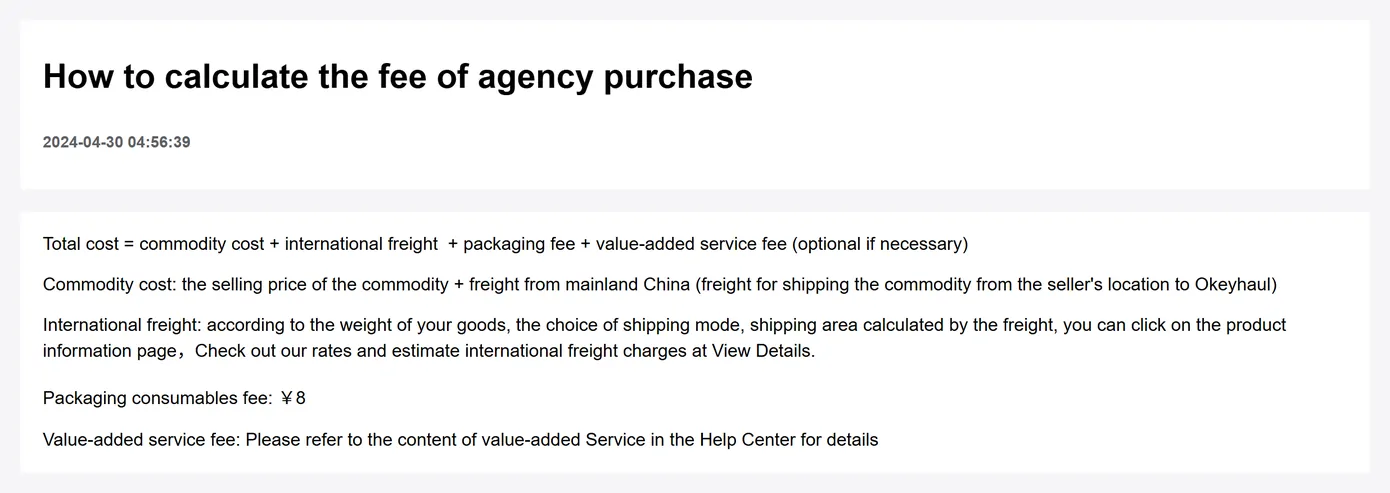
1. commodity cost (the seller's price plus freight from the seller to the Shenzhen warehouse)
2. international freight
3. packaging consumables fee
4. value-added service fee, only if you order one
Note what the first part quietly includes: the freight from the seller to the warehouse is part of the commodity cost. That domestic leg is already in your bill, which is why buying two items separately costs more than buying them together. The packaging consumables fee is published at 8 CNY.
None of that is unusual, and none of it is hidden. What catches people is that three of the four parts cannot be known at the moment you first pay.
Source: Okeyhaul help article 223, read 2026-10-07. The four parts and the packaging fee are the operator's own published values.
Four moments
The four published moments money moves
Each row below is quoted from a separate Okeyhaul help page. These are not risks somebody inferred: they are documented mechanisms, and knowing them turns a surprise into a step you were expecting.
| When | What happens | Who absorbs it |
|---|---|---|
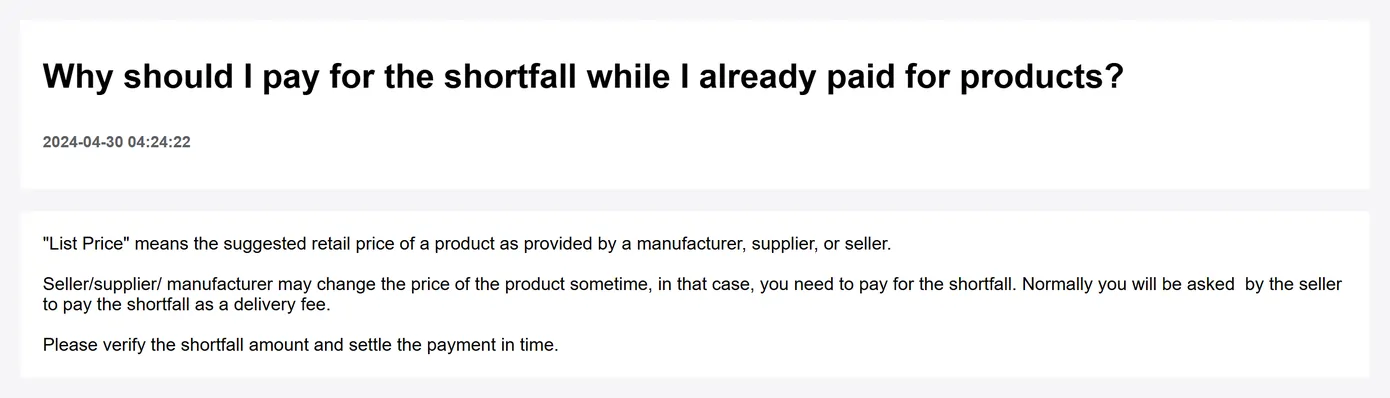
| The seller's price moved after you paid | Seller/supplier/manufacturer may change the price of the product sometime, in that case, you need to pay for the shortfall. | You. Published on help article 214. |
| The parcel is re-weighed after it is packed | Okeyhaul first collects the freight based on the weight of the goods when the goods are in the warehouse. The warehouse will complete the packaging within 24 hours after the waybill is submitted. The overcharged amount will be refunded to the account balance; the undercharged amount will be deducted from the account balance. | You. Published on help article 254. |
| A light but bulky find is billed on volume, not weight | The volume weight value is compared with the actual weight value, and the larger value is used as the chargeable weight value | You. Published on help article 256. |
| Several items from one seller in one order pay domestic delivery once | If you buy all the products from the same seller, submit them, and settle payment all in one purchase order, then Okeyhaul will only charge you a domestic delivery fee once. | You. Published on help article 222. |
Re-weighing, in the order it happens
This is the mechanism behind the most common complaint in this market, and it is documented in full. Four steps, no discretion.
Freight is charged on the warehouse weight
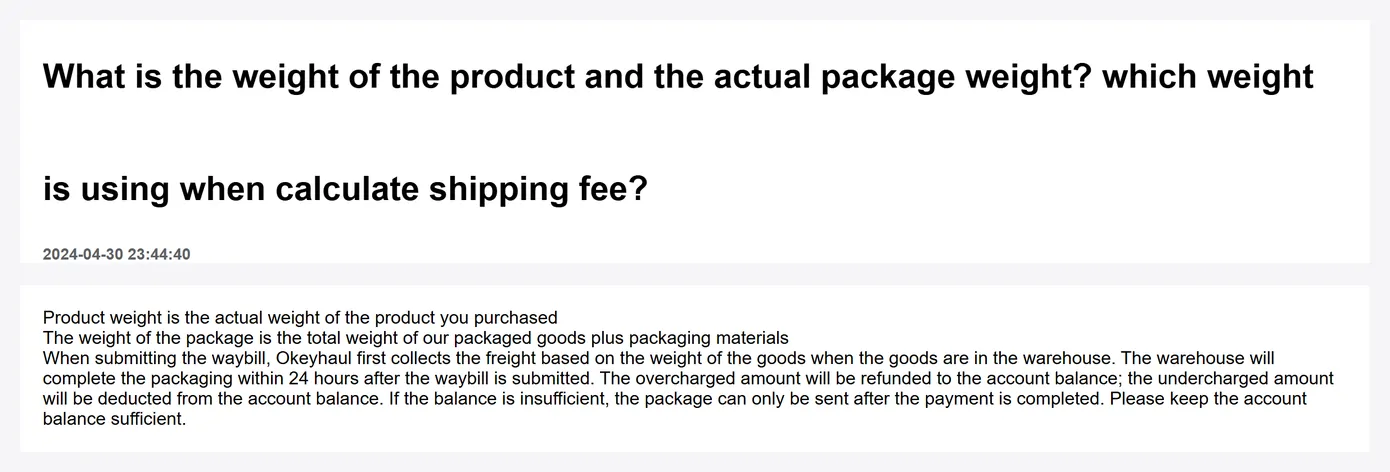
Freight is first collected on the weight of the goods in the warehouse. At this point nothing has been packed, so the figure is the weight of the goods as they sit on the shelf.
The warehouse packs within 24 hours of the waybill
Packing adds material and it adds dimensions. Both can move the chargeable figure, and the second one moves it more often than the first.
The difference settles against your balance
An overcharge is refunded to the account balance. An undercharge is deducted from the account balance. There is no negotiation step and no notification step described.
A short balance holds the parcel
If the balance is not enough the parcel only moves after the shortfall is paid. This is the one that strands people: the parcel is finished, paid for once, and simply does not move. Keep a small float in the balance and this step never happens to you.
Why a light parcel can cost what a heavy one does
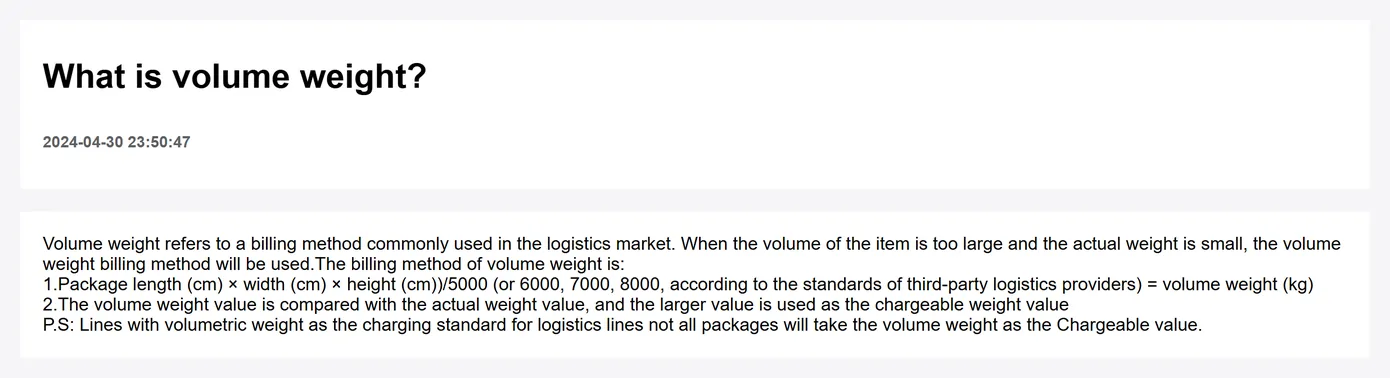
Carriers bill the space a parcel occupies as well as its mass. The published formula is length cm x width cm x height cm / divisor, and the divisor belongs to the carrier rather than to Okeyhaul: the pages name 5000, 6000, 7000, 8000 as the ones in use. The larger of the volume figure and the actual weight becomes the chargeable weight.
Work an example with the smallest divisor and the arithmetic speaks for itself. A box of 40 by 30 by 25 centimetres is 30,000 cubic centimetres, which at a divisor of 5000 is 6 kilos of chargeable weight no matter what the scale says. Puffer coats, boxed sneakers and anything with a rigid case live here.
One honest caveat, published on the same page: not all packages will take the volume weight as the Chargeable value
Which carrier applies it, and which divisor, is not something you choose.
Source: Okeyhaul help article 256, read 2026-10-07. The formula, the four divisors and the caveat are all from this page. The worked example is our own arithmetic on the published formula.
The rate
Exchange rate: the rate you actually pay, and when it is set
A listing is priced in CNY. You hold something else. The question that decides your real cost is not what the rate is today, it is at which moment your money gets converted, and that differs by payment route.
Okeyhaul states that it re-reads the bank rate and adjusts from time to time, so there is no fixed rate to plan against. What you can control is how many conversions your money passes through.
One conversion, fixed at the moment you top up
No conversion at the moment of paying; the rate was fixed when you topped the balance up. Your exposure ends when the balance is funded, which means you can top up when the rate suits you and spend later at a rate you already know.
This is also the route Okeyhaul recommends in writing: To reduce exchange losses, it is recommended to use balance payment.
Two conversions, and the middle one is not yours
Quoted: No matter what kind of currency account is used, payment through Paypal will be converted in the currency of U.S. dollars.
If your account is not in dollars, your money converts into dollars and then out again, and you pay the spread twice without seeing either leg.
No handling fee stated
No handling fee stated on the page we read. Absence of a stated fee is not the same as a confirmed absence of cost, so treat it as unknown rather than free.
Questions about money
Related: the shipping methods and the customs thresholds, and what the storage clock costs you.
Why was I asked for more money after I had paid?
One of four documented mechanisms, most likely either a seller price change or the post-packing weight reconciliation. Both are quoted in the table above with their source pages.
Can I avoid the volume weight charge?
Only by changing the parcel, not by changing the agent. Removing a shoe box, combining items into one carton and avoiding rigid cases are the levers. The divisor is the carrier's.
Is the balance safer than paying per order?
It is more predictable, which is not the same thing. It fixes your rate at top-up and it covers the weight reconciliation automatically so a parcel is never held for a few yuan. The trade is that the money sits with the agent.
The totals on the order form had a dollar sign but the inputs said CNY. Which is it?
We saw exactly that on the custom order form and we are not going to guess which is authoritative. Read the currency label next to every figure before you accept a total, and if the two disagree, ask before paying.