Pitfalls worth knowing before you commit
None of what follows is a complaint about Okeyhaul. Every item on this page is documented on its own help pages, which is precisely why it is avoidable. The pitfalls that cost people money are the published ones nobody read.
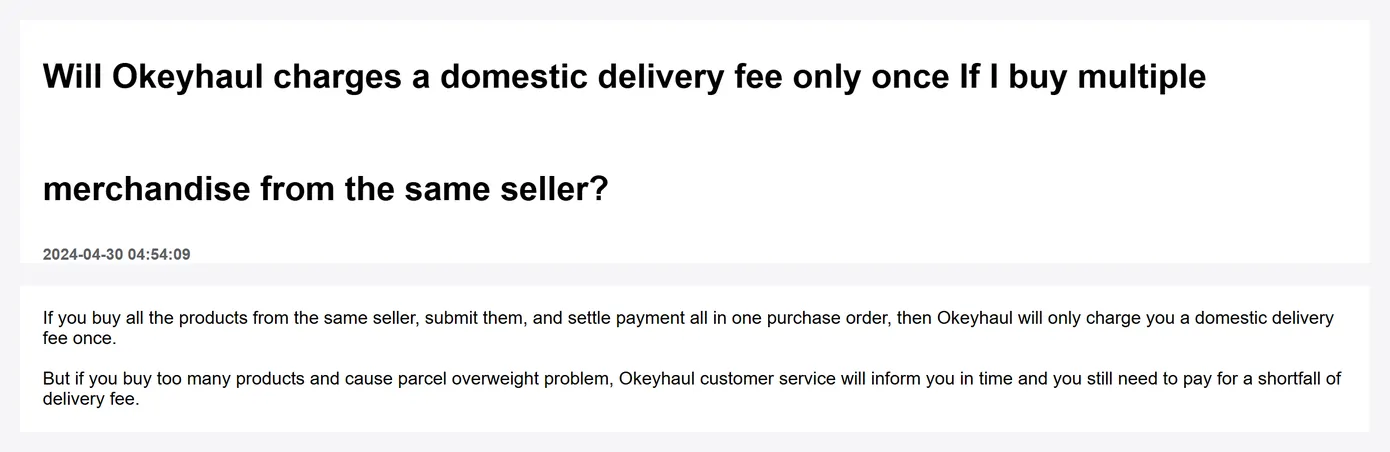
Start with the cheapest one to avoid. Domestic delivery inside China is charged on the way in to the warehouse, once per inbound shipment. Quoted: If you buy all the products from the same seller, submit them, and settle payment all in one purchase order, then Okeyhaul will only charge you a domestic delivery fee once.
So two items bought from two sellers on two days arrive as two inbound shipments and carry two domestic legs, both of which are already inside the commodity cost you paid. Buying the same two items in one go, from one seller, costs less for reasons that have nothing to do with the goods. If you are planning several orders, plan the order of them.
Source: Okeyhaul help article 222, read 2026-10-07. The inbound charging rule is quoted from this page.
Three answers
How long will the warehouse hold it? Three published answers
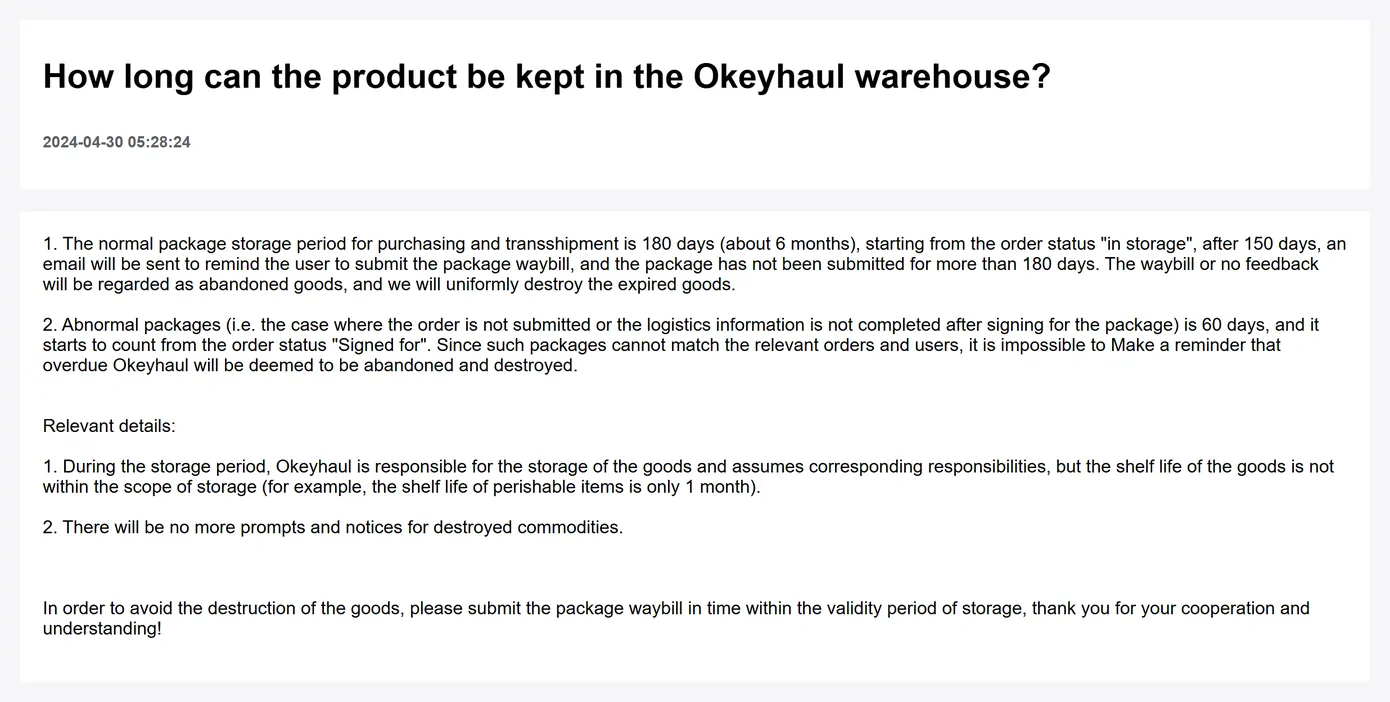
This is the one we could not resolve, so we are not going to pretend we did. Okeyhaul publishes three different free storage periods on three different help pages, each with its own starting trigger. We read all three on 2026-10-07 and they do not agree.
Treat the shortest as your working deadline. That is the conservative reading and it is the only one that cannot cost you a parcel.
| Published period | Where it says so | What it says it counts from |
|---|---|---|
| 90 days | Help article 278 | Shopping Agent preservation period of parcels is 90 days, calculates from the order status "stored". |
| 100 days | Help article 241 | The free storage period of goods starts from the time when the order status is changed to "package can be submitted". Goods over 100 days will be overdue. |
| 180 days | Help article 227 | The normal package storage period for purchasing and transshipment is 180 days (about 6 months), starting from the order status "in storage", after 150 days, an email will be sent to remind the user to submit the package waybill. |
There is a fourth, separate figure for parcels that go wrong: an abnormal package, meaning one signed for but never submitted or never completed, is published at 60 days from the signed-for state. That clock is shorter than all three above and it is the one running when you have forgotten about an order.
Buying more time, and what it costs
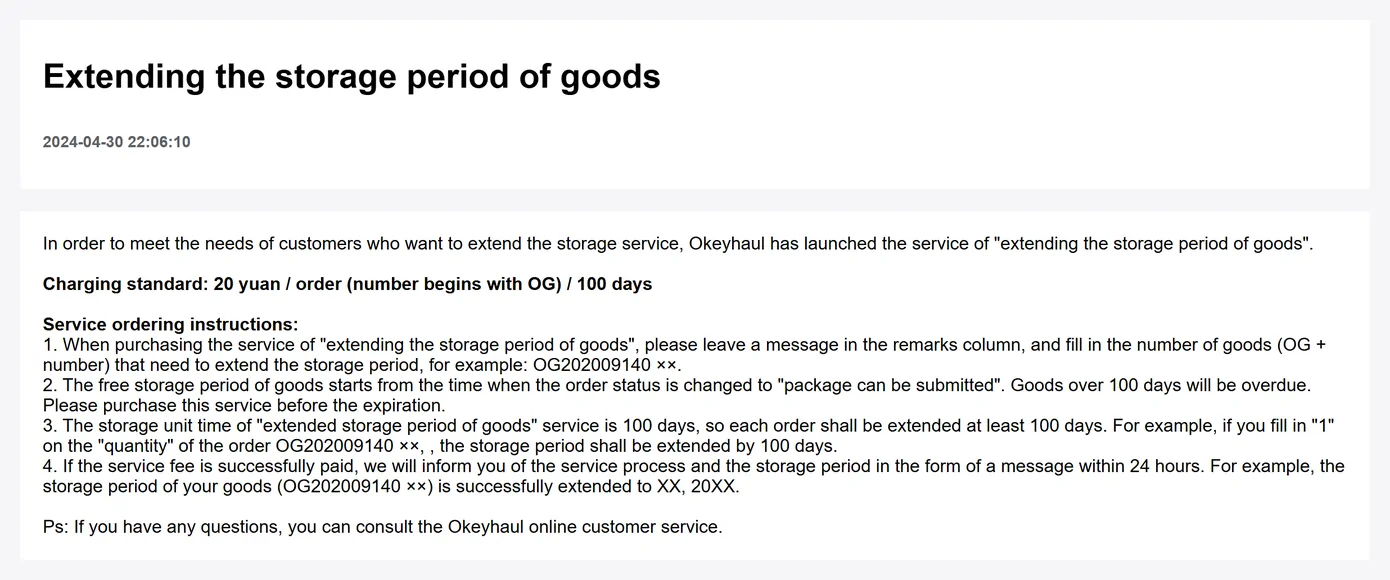
The storage clock can be extended, and the price is published: 20 CNY per order, per 100 days. That is cheap enough that it is worth knowing about before the deadline rather than during it.
It is also the clearest signal about which reading of the storage period actually governs in practice, because the page that sells the extension is the page that publishes the 100 day period. We are noting that rather than concluding from it: a fee schedule is not a policy statement, and we are not going to turn one into the other.
The practical move is unglamorous. Decide your parcel before the shortest published clock runs out, and if you cannot, pay the extension rather than gamble on which page wins.
Source: Okeyhaul help article 241, read 2026-10-07. The extension fee and the 100 day period are both the operator's own published values on this page.
Returns: the window, and the ten things outside it
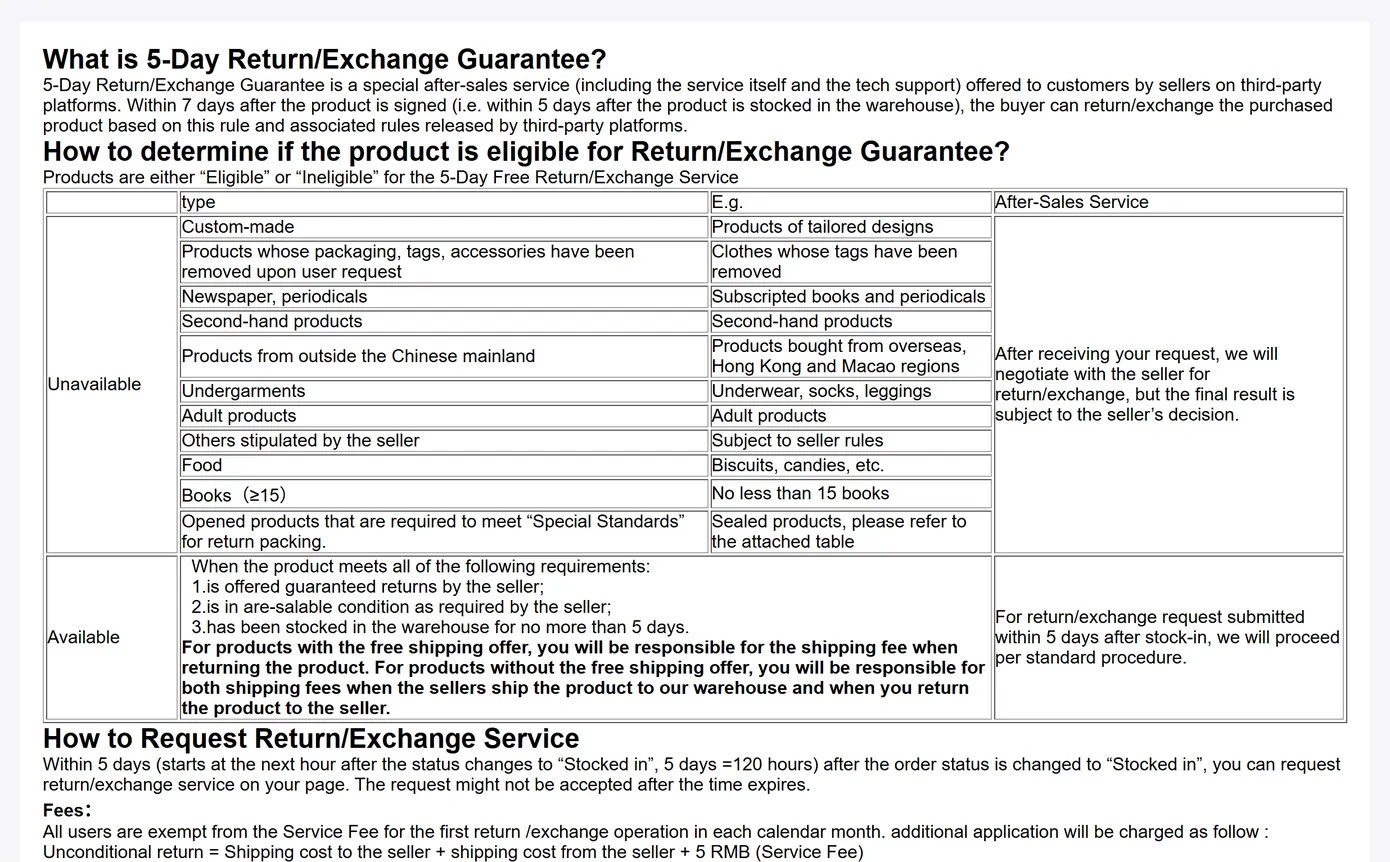
There is a return window and it is narrower than most people assume. Quoted: Within 7 days after the product is signed (i.e. within 5 days after the product is stocked in the warehouse), the buyer can return/exchange the purchased product
Read the bracket in that sentence. The clock that matters for most orders is the one counted from stocking, not the one counted from signing, and it is the shorter of the two. One more thing is published plainly and it governs everything else here: the seller decides; Okeyhaul negotiates but the outcome is the seller's.
Inside the window
- A product that arrived and is still as it arrived
- Packaging, tags and accessories all intact
- A decision made within the published days, counted from stocking
- A fault you can point at in the warehouse photographs
Published as not returnable
- Custom-made products of tailored designs
- Products whose packaging, tags or accessories were removed at your request
- Clothes whose tags have been removed
- Newspapers, periodicals and subscribed books
- Second-hand products
- Products bought outside the Chinese mainland, including Hong Kong and Macao
- Underwear, socks and leggings
- Adult products
- Food
- 15 books or more
What to do when the clock is nearly out
Four steps, in the order that costs least. Do them in this order and the extension fee is usually the worst outcome.
Find out which state your order is actually in
Every one of the three published storage periods counts from a different order state. Until you know your state, you do not know which clock you are on, and the states have confusingly similar names.
Assume the shortest published period applies
The shortest of the three published readings is 90 days. Planning on it costs you nothing if a longer one turns out to govern, and planning on the longest costs you the parcel if it does not.
Submit the parcel rather than wait for a better plan
Submitting starts a different and much shorter set of clocks, and it takes the storage question off the table. A parcel you are not entirely happy with is worth more than one that was disposed of.
If you genuinely need longer, pay the extension
20 CNY per order, per 100 days is the published price. Weigh it against the goods, not against your irritation at having to pay it.
Questions about things going wrong
I ordered the wrong size. Can I change it?
Only before the seller has dispatched. Okeyhaul states that it will contact the seller and exchange the goods while the package has not been sent, and that once it has been sent an exchange is not available. After arrival, an exchange after arrival means you pay the return delivery fee.
I was told the item is out of stock after I paid. Why?
Because stock figures on the source platforms are not reliable, which Okeyhaul publishes rather than hides: sellers do not update their inventory in time, so an order can be processed and then come back as unavailable. Judging a seller covers how to reduce the odds.
My parcel has not moved and nobody is telling me why.
Check your balance first. A re-weighing shortfall holds the parcel until the difference is paid, and the published mechanism does not describe a notification step. The re-weighing sequence is here.
Can I get the seller to take it back if the check found a fault?
Okeyhaul negotiates, but the published position is that the outcome is the seller's. That is worth knowing before you plan around a return rather than after.